Tuesday, October 11, 2011
1st Annual Meyers Climbing Competition Video
Check out this cool video from the 1st Annual Meyers Climbing Festival! This was made by a cool climber we met that day as we made our way through the excellent boulder fields of South Lake Tahoe!
Make sure to pay special attention early on to the young kids (0:41) who are already pulling down hard!!!


Monday, September 26, 2011
Trip Report: Yosemite Facelift 2011

On Thursday night, our crew assembled at an apartment in San Francisco with well laid plans for a night of revelry before an alpine start up to the Valley on Friday morning. We went out, had a few drinks, a few laughs, and then headed back for a fitful night's rest - all of us reporting the next morning that our Quake City bivy had been difficult due to the rumblings of excitement we were all feeling.
We awoke, had a quick breakfast of bagels and coffee, and hit the ground running at 0' dark thirty.
Our friends Jeff and Mandy (see Stinson Beach and Tahoe trip reports), were joining Thuy and I for a weekend of climbing and picking up trash as part of the Yosemite Climbing Association's 9th Annual Yosemite Facelift, where climbers and friends work to rid the Park of waste. It would be Jeff and Mandy's first Facelift, and Thuy and I's second. And while Mandy had been to Yosemite before, this would be Jeff's first pilgrimage to what is one of, if not the, mecca of world rock climbing.
Passing the turnoff for Foresta, I began to pay close attention in the rear view mirror to Jeff's facial expressions. I knew that he would soon get his first glimpse of the Valley, and being that he is a climber with a deep love of crack climbing in places like Joshua Tree and Cochise Stronghold, I knew he was about to recognize this granite paradise for the Shangri-la that is is. Sure enough, he began hyperventilating at Tunnel View and caused one of our group to earnestly suggest to him he take deep breaths and try to avoid panicking!

We ditched the car and made a beeline for the Penthouse Cracks, a row of four cracks that begin off a large flat granite balcony thirty feet or so off the Valley floor at the far edge of Camp 4. We took turns top-roping each of these lines, repeatedly exclaiming how incredible the rock quality is, offering perfect hand and finger jams, difficult and thought provoking foot work on glacier polished granite, and having that special characteristic of some climbing mediums and routes that offer up holds or stances exactly where necessary but seemingly no where else...As if the geological process had taken place with future human climbers in mind!


Climbing in a light sprinkle, we thought we heard some thunder and decided to pack it in and run a few errands before the great Jim Donini's presentation in the East Auditorium that was one of the week long Facelift's evening events.

We arrived early and after wandering around star struck by many of the luminaries of Yosemite's amazing climbing history, we took our seats and listened as Jim Donini told us about first ascents in Patagonia and Alaska, his epic with Jeff Lowe, Michael Kennedy, and George Lowe on Latok I, and about his most recent adventures to Tajikistan and Iran. We also noted how unique and interesting it was to hear about his first ascent of Torre Egger in Patagonia with John Bragg and Jay Wilson, where they had found much of Maestri's gear on the way up, but how it stopped short of even the Col of Conquest, and how therefore, Donini, once a Maestri believer (more it would seem out of a standard ethic of believing another climber at his or her word, rather than questioning everything and becoming embroiled in the ensuing controversy), could no longer accept the Italian's original reports of successfully summitting Cerro Torre.

The next day we went to Sunnyside Bench where we found the classic two-pitch Sunnyside Jamcrack (P1, 5.7; P2 5.9) route jammed up with a queue of waiting climbers. Instead of waiting idly, Jeff jumped on the lieback flake route, Lemon (5.9), and set up a top rope. Thuy, Mandy, and I each climbed this less somewhat less popular route and loved every second of it. If it was only longer I'm certain more climbers would find this route to be a classic!


We then climbed on the .10d and .10c cracks between Lemon and Sunnyside Jamcrack, where Thuy turned in an awesome performance by hanging in there and completing the difficult lieback section at the end of the .10d!


We took turns on Jamcrack and then packed up and went to check in at the Facelift stand as volunteers.

We were armed with our litter sticks and trash bags just before a violent lightening storm and heavy rain hit the Valley. We waited out the rain and in the evening went for a short hike to the Indian Caves and the nearby boulders before turning in for the night.
We awoke Sunday morning and spent a few hours scrambling around in the Lower Yosemite Falls amphitheater and drainage finding hats, water bottles, food trash, steel cables, and even two shoes! We had a blast doing this and as a group hauled out 16 pounds of trash. We were disappointed that we weren't able to volunteer more, as in 2009 when we volunteered for five full days, but felt great that we were able to participate at all and each of us related to the others the psychic bounty our efforts bestowed upon us. I for example, while staring deep into the meadow grass along the road looking for trash realized suddently how beautiful these meadows are in their own right, whereas on all these trips over the years, I'd overlooked them (quite literally) as my gaze was affixed higher on the Valley's towering walls.

We dropped off our haul, and went to Camp 4 for one last bit of climbing where Jeff made short work of Grant's Crack, a fun, thin 5.9 set of parallel finger cracks that curves up and right to an anchor at a tree.
Jeff and I headed back and got into the car to head home, but not before giving serious consideration to the idea of sending Mandy and Thuy home with the car, forgetting our more urbane responsibilities, and staying in the Valley until further notice. Prudence got the better of us this time, and we settled for plans to come back in a week.
Many thanks to Ken Yeager and the rest of the Yosemite Climbing Association and Facelift volunteers for working so hard to keep the Valley clean and beautiful and for the incredibly special evening programs. Thanks also to my companions for such a wonderful trip!

Tuesday, September 20, 2011
Joshua Tree National Park
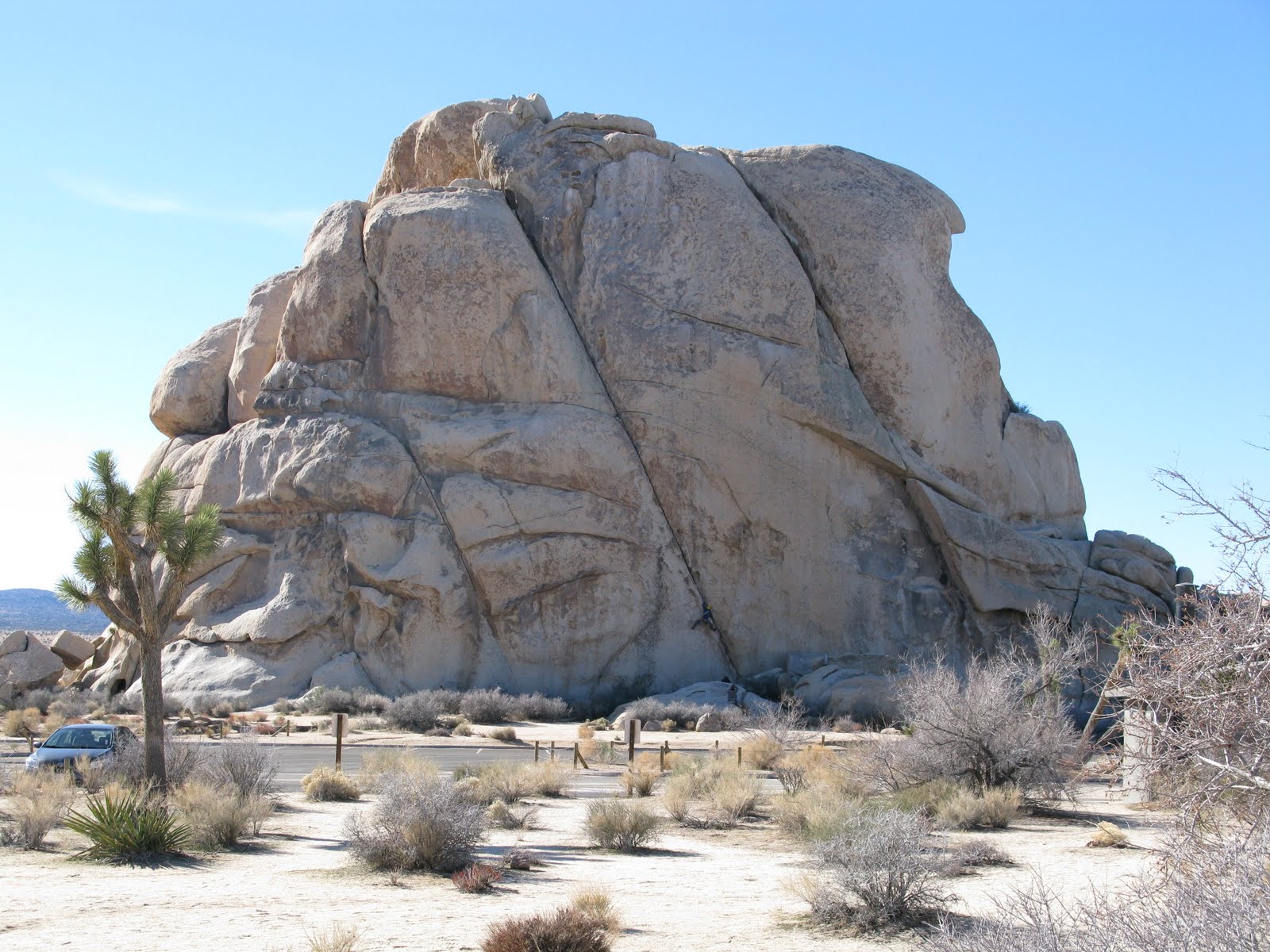
Joshua Tree National Park
Joshua Tree National Park is a virtual climber's paradise. 1,235 square miles in size, Joshua Tree, declared a National Park in 1994 as part of the California Desert Protection Act, is home to (by some estimates) greater than 5,000 established rock climbs.
The rock, a highly textured, large grained granite called monzonite, leaves fingers painfully raw, but provides some of the most excellent friction and feel of any rock I've ever climbed.
Driving into the Park's west entrance from the town of Joshua Tree off Twenty Nine Palms Highway, visitors are immediately confronted by the overwhelming beauty of the Mojave Desert that makes up the parks western half. The Mojave Desert is a 'high desert' or one that is at an elevation of greater than 3,000 ft. Here the desert is not only replete with the Park's namesake Joshua Tree's which rise as high as 15 meters, but also with thousands upon thousands of boulders and smallish rectangular formations littered with cracks strewn in heaps across the landscape. If you are visiting the park to climb, this should elicit in you a near panic level exuberance. If not, you should probably just turn back and attempt to hock your shoes for pocket change.
A few side notes on flora and fauna
Joshua Trees, beautiful and otherworldly, are actually not trees at all but giant Yucca plants. Yucca brevifolia have no growth rings and are therefore difficult to date, but it is estimated that they live for hundreds of years. The plant was given its name by Mormon settlers who crossed the Mojave Desert in the mid-19th century who saw in the tree the Biblical image of Joshua reaching with his hands in prayer towards the sky.

The high desert has more precipitation than the low Colorado Desert in the park's eastern half and offers visitors views abundant wildflowers in the spring as well as a bevy of various types of cactus and shrub.
Wildlife is also abundant in Joshua Tree, the park home to six species of snakes (be careful when scrambling on and over rock formations and keep an eye on the next step!), coyotes, tortoise, Desert Bighorn Sheep, tarantulas, and over 250 species of birds (including the Greater Roadrunner!)
Geology
The rock formations in Joshua Tree formed 100 million years ago as a result of magma cooling beneath the surface. Over time, groundwater has eroded away at the desert leaving exposed thousands of formations of similar height covered in cracks.

Where to Stay
Visiting climbers are drawn to the famed Hidden Valley Campground which is the first you will reach when entering the park's West entrance. Winter home to the legendary California climbers known as the Stonemasters, Hidden Valley Campground sits among and within walking distance of many of Joshua Tree's classics.
Hidden Valley Campground has 39 walk-in campsites that allow for up to 2 vehicles, 3 tents, and 6 people. There is a annual 30 day limit on camping in Joshua Tree, and a 14 day limit between the popular October - May time frame. It is often very difficult to get a spot if you arrive on a weekend in any other season but the usually too-hot-to-climb summer. For better luck, take a day off work and head down on Thursday instead. There is no running water, but several usually clean pit toilets. Each site has a picnic table, fire pit, and typically a nice, level area on which to pitch tents. If Hidden Valley Campground is full, try asking people already camping if you can share their spot. This is a not uncommon practice, and is actually a great way to meet new climbing partners. Just make sure to offer to buy a few beers for your hosts!

If you are the type of climber that prefers to stay in a hotel with running water, etc, you might check out the Joshua Tree Desert Inn in the town of Joshua Tree. This is the famous hotel where musician Gram Parsons (Flying Burrito Brothers, The Byrds, etc) died of an overdose in room #8. The room contains a stereo with a stack of Gram Parsons albums next to it, and a shrine out the door of the room where travelers and fans of the country/blues/folk/rock (according to a wikipedia article about the artist, this is called, "Cosmic American Music") musician can leave offerings. On my one stay there, several college aged girls twisted my arm into participating in a failed seance in the room where Gram passed. It was a tad unusual, but that's all part of the Joshua Tree experience!
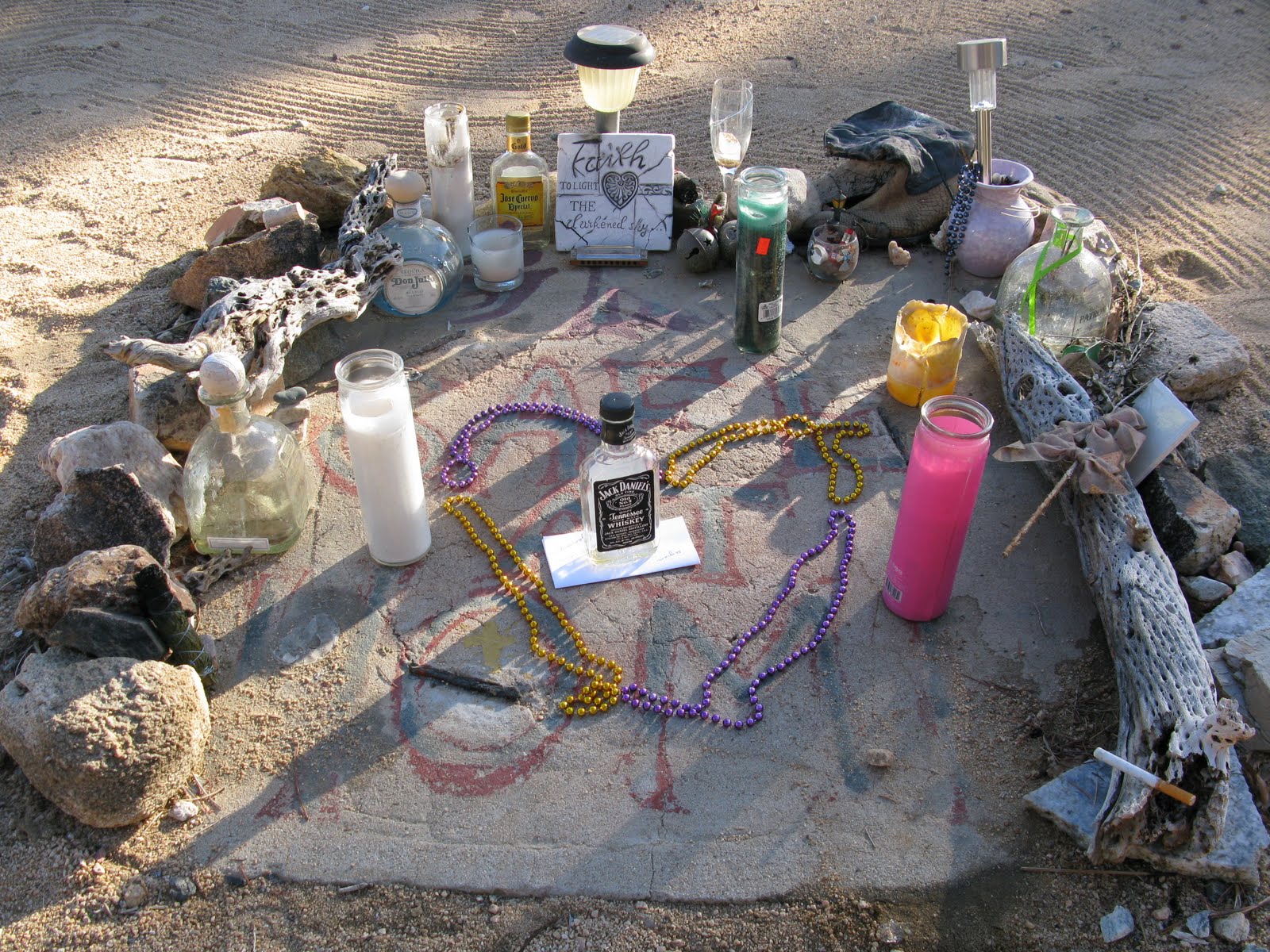
Interestingly enough, Gram's body disappeared from LAX, when road manager Phil Kaufman and a friend stole the body in a borrowed hearse, and drove the remains to Cap Rock in Joshua Tree (near Hidden Valley Campground) and cremated Gram's body according to the artist's wishes. As there is no law against stealing a dead body given that it has no intrinsic value (according to law), the body snatchers were given a small fine and released.
The hotel is currently managed by a great dreadlocked man named Marsu who makes homemade Chai tea for all his guests. If you'd like to see the room and shrine but aren't staying at the hotel, and Marsu still works there, its almost a given that he'd love to give you the tour. Stop on in and ask nicely to see the memorial and he'll probably make you some tea while you wander the grounds.
Food and Drink
In the town of Joshua Tree there is a giant Walmart where one can fill up on food, wood, and beverages cheaply. There is also a Pizza Place just outside of the Park called Sam's Pizza, where they serve not only serve Pizza, but also Indian food. They combine these two talents and make an 'interesting' curry sauce pizza that many climbers claim to crave at the end of a long day. I myself wasn't overly impressed by the curry pizza, but the regular pizza and other items are delicious. The same owners of Sam's Pizza also run a convenience store next door that sells firewood, alcohol, and snack foods.
Climbing Gear
Getting into off widths and need a few big bros? Run out of chalk or need tape for your shredded hands and fingers? Check out Nomad Ventures on the corner of Park Blvd and Hwy 62.
Showers
Showers can be found at Coyote Corner across the street from Nomad Ventures. Tokens for the shower are $4 and are good for 7.5 minutes of water.
Climbing Guides
Climbing guides are available through Joshua Tree Guides. They offer many different rates and packages. For more information, visit their website at http://joshuatreeguides.com/.
Directions from the Bay Area: Take 580 E to CA 120 E, then merge onto CA-99 S. Take 99 S to CA-58 E/Blue Star Memorial Hwy to I-15 N toward Las Vegas briefly before turning onto CA-247 S/Barstow Rd. Turn left onto CA-62 E/Twentynine Palms Hwy to Park Blvd. The drive takes approximately 9 hours, but I guarantee its worth it!!!
Favorite Routes
Hemingway Buttress
Feltoneon Physics (5.8)

This 100 foot tall trad line lies just off Park Boulevard approx 2 miles from Hidden Valley Campground. Park at the large pullout for Hemingway Buttress and hike towards the center of the wall. This climb starts approximately 40 feet to the right of the classic hand/fist crack, White Lightning (5.7). Featuring a wide crack/OW start in a right facing corner (that can be somewhat avoided by moving out onto the face of the buttress), the climb then ascends through excellent hand and finger cracks to a traverse below the summit, and a mantel up between two boulders. For a 100 foot line, this climb felt very adventurous given the heterogeneous nature of its features, its airy traverse (Note: leaders remember to protect your seconds by placing gear at the start and finish of the traverse!), and its mantel finish. Rappel off White Lightning with two ropes, or with a single cord approx 25 feet left of the climb (but note you will end up 7-10 feet off the ground and will need to downclimb easy face holds to complete the descent. I highly recommend this route!
Echo Rocks Area
Eff Eight (5.8)

This 40' Trad line feels like quite the sandbag and is definitely a difficult lead given its unsual placement opportunities. The climb ascends a 40 foot hand crack that curves left off the desert floor. Located in the Echo Rocks Area, this climb receives near perfect sunlight during the day, has a two bolt summit anchor, and features a nice and easy walk-off. If planning to TR this climb, bring long slings to reach from the bolts out over the lip of the climb. While challenging and a bit of a physical struggle rather than an opportunity to practice smooth crack climbing skills, its position, its easy approach, and the bolts making for an ideal top rope for those unused to trad anchors, this climb warrants inclusion in the Bay Area Climbers' To Do List. Park in the Echo Cove Parking lot and hike towards the large Echo Rock. When you near the West End of Echo Rock, turn right and head out into the open expanse on a well worn trail. Eff Eight will be the prominent left slanting crack on a large boulder directly in front of you. To descend, use the easy walk off on climber's left.
Double Dip (5.6)

Double Dip seen on left side with the flake. Stitcher Quits is the prominent black streak on the right. This is Echo Rock, West Face, as seen from the parking lot approach.
Located on Echo Rock's North Face, this 110' sport climb ascends the right side of flake before cruising up the lower angled dome to a nice flat bench finish high off the desert floor. The climb is runout and the flake at its start can be protected with a single cam (#3 or #4) near its top. Ascend the outside of the flake (lieback) for the most straightforward experience. From there one move puts you to the second bolt (don't blow this clip (or fail to put in a cam behind the flake) or you will deck!) After the second bolt, the climbing is easy face climbing and offers quite a few positive holds to say its a slab. Its pure fun, although runout with only 5 bolts in 100' plus. A great alternative to the most popular (but usually crowded) Stitcher Quits (5.7) that ascends the prominent black dike to the right of Double Dip. There is a two bolt anchor. Descend the slabs to climber's left. Pretty classic climb for the grade and I highly recommend it!
Hidden Valley Campground
Hands Off (5.8)

Located inside Hidden Valley Campground, Hands Off (5.8), is a somewhat difficult 5.8that combines stemming, jamming, and some thrashing, to ascend this varied and fun route. Brings #4s for the anchor and smaller gear for the climb itself. To descend, walk off to climber's left down the backside on a somewhat steep slab. Curve back towards hidden Valley and downclimb to the base of the route. The downclimb is not too bad as far as Joshua Tree is concerned. This is a John Long FA and a very popular climb.
Beginner's Three (5.3)

Located on the backside of Intersection Rock, this low angle hand crack ascends a prominent buttress for 50'. Protection opportunities are available throughout, making this a good beginner's trad lead. It does however finish on a low angle slab that appears to have a crack in it when viewed from the ground, only to turn out to be a shallow streak that offers no protection. The angle is quite low here, but this should be known before leaving the ground to avoid the surprise a beginner would feel to suddenly be confronted with a lack of pro. The climb finishes on the shoulder of Intersection Rock below Overhang Bypass. Build an anchor in the horizontal crack that is positioned approx 10 feet from the lip of the climb. Downclimb off to climber's left (not too bad.)
Double Cross (5.8)
An absolute Joshua Tree classic. This 5.7+-5.8 route offers some of the best hand jamming I've ever seen. It is unfortunately the site of quite a few accidents probably owing to its 25' of essentially unprotected (but easy) face climbing before the start of the crack and due to its fame as a classic Joshua Tree solo. After the face moves, its 70' of beautiful and rythmic crack climbing. Rap anchors are to climber's right. Takes a standard rack with cams up to 3" with doubles (or triples) of #1s and #2s.
Quail Springs
Trashcan Rock, located just off Park Boulevard approximately 3 miles from the Park's Western entrance, this rock sees a lot of traffic from both guide groups and tourists given that it features a large parking area, picnic tables, and 5 second approaches. While not a remote wilderness setting, it does offer a lot of climbing in a short period of time given the availability of easy-to-moderate trad routes and moderate sport climbs.

1. The Trough (5.0) - A great, but short (20') beginner's trad line
2. Karpwitz (5.6) - A nice fun, trad line with varied movements
3. B-3 (5.3) - Trad, anchor in horizontal crack above.
4. Profundity (5.10c) - Sport. Thoughtful, fun moves on an inobvious line.
5. B-2 (5.3) - Trad. The least enjoyable of the 5.3 and below trad lines on the face.
6. Tiptoe (5.7+) - Sport. A great line that moves up a feldspar dike. First bolt is way off the ground though and should be (dare I say it!) stick clipped if possible.
7. B-1 (5.1) - Trad. Fun face moves on patina flakes compliment a few nice hand jams.
Lost Horse Area
Atlantis Wall

To reach the Atlantis Wall, turn off Park Boulevard onto the dirt road through the Lost Horse Area. Park at the last dirt pullout before the 'Service Only Road' sign. Hike in on a well worn trail along rock walls until you can turn left up and into a Canyon. There on your left will be the very popular and fun Atlantis Wall.
On the Atlantis Wall are a number of great beginner trad climbs that can also be toproped by walking up the easy gully on the backside (Class 2?). Trad anchors and long slings are necessary to rig ropes, but a number of large boulders atop the formation offer strong and easy to use anchor points.
In the photo above, left-to-right, are:
Solar Technology (5.6), Men with Cow's Heads (5.5), Wet Pigeon (5.8), and Taurus
(5.7). We found everyone of these climbs to be fantastic. They make for great beginner's leads given the shorter nature of the wall (50') and due to the plentiful protection opportunities throughout each climb.
Please let us know what you think of these routes and let us know if you have favorites you'd like us to include! Many thanks, Bay Area Climbing Staff!

Monday, September 19, 2011
1st Annual Meyers Climbing Festival & Bouldering Competition

 We awoke at 4:45 a.m. on Saturday, September, 17th, brewed a giant pot of dark coffee, loaded up our car, and hit the ground running. We arrived in Meyers (4 miles south of Lake Tahoe) at around 8:30 and parked in the lot next to the Divided Sky bar and restaurant. There we met up with friends Jeff & Mandy, registered for the comp, and after milling about and meeting a few dozen other climbers, we headed straight to the Pie Shop Boulders.
 Located just North of the Agricultural Checkpoint in Meyers, the Pie Shop Boulders sit just off the right hand side of the road 0.25 miles after turning left onto Sawmill Pond Road. Park in the dirt pullouts on the left. (Note: There are homes adjacent to this area, so please be respectful and noise conscious entering and exiting the Pie Shop area to ensure continued access!) The boulders here feature very large grained granite leaving very sharp and friction-friendly boulders. There is everything from patina faces, to cracks, to exfoliating flakes. There are traverses, highballs, overhangs, slabs, and sit-start aretes. Basically, some of everything, just come prepared to lose some skin!
Upon entering the area, we approached our first problem for the day. A mid-height crimper affair on mostly featureless granite. Excited, I threw my boots on and fired the thing, laughing and jokingly congratulating myself for a flash ('flashes' or 'on-sights,' given extra weighting in this comp, refer to the successful ascent of a boulder, problem, or route without ever having seen or tried it before...). Only then did I realize I had committed bouldering's original sin and forgotten to circle the boulder first to ensure and locate an acceptable down climb. Benighted for a few minutes, our small posse had a good laugh before I finally negotiated a partially blind and slightly overhanging down-climb off the back side.
Now both physically and mentally warmed up, we began a nearly two hour rampage through Pie Shop's spectacular offerings. All throughout the boulders grappled fellow competitors, the spirit of the day less competitive, and more the jovial collegiality of climbers enjoying a beautiful mid to high-70's day in the insurmountable beauty of the Lake Tahoe area of the Sierras.
Gang spots, stacks of crash pads, and cheering sections lead each of us to surpass ourselves. High balls and problems of each successive difficulty fell as the energy rose.


Our fingers already beginning to show significant wear and tear, we decamped and headed for the small local grocery. After restocking our supplies, we went back down Sawmill Pond Road to its terminus at Lake Tahoe Boulevard. There at the top of the 'T' at the intersection there is a large dirt parking area. Twenty feet behind the 'T' is the Glass Boulder, likely named for the unfortunately high quantity of broken glass at its base. On this note, a suggestion: If everyone bouldering here picked up one or two pieces of glass on their way out, this area might see improvement. We cleaned up what we could find, but I'm sure we missed some. Keep an eye out and be careful if walking barefoot around the boulder between attempts!!!)
The Glass Boulder sits approximately 15 feet high and has several excellent lines on it - all in the sub-V4 range. It can be a bit high in places, but has a nice and easy sloped descent line. We greatly enjoyed a V2 arete problem on the back left side and a V2/3 SDS ('sit down start') to crack line. Jeff sent an amazing flaring corner which we believe may be V4-ish, before Thuy topped-out the crack problem with an unbelievable heel-hooking mantel. We cheered her courage and ingenuity. Breakthrough moments! So fun to watch, experience, and be a part of one another's athletic and mental breakthroughs! The best part of it all of course is that, in climbing, as long as you are excited and challenging yourself, it's 'always just the beginning!'

We went back up Sawmill Pond Rd and turned off onto the Access Road for Sawmill Pond. There is a large paved parking lot with two pit toilets and trash cans next to the pond. We parked here and after a short walk up a dirt road arrived at the Hemorrhoid Boulder. There looked to be many great problems here, but as it was surrounded by a large throng of climbers, we went back down towards the road and after a brief hike into the woods, arrived at the Bob Boulder. This boulder is high and steep and offers several problems from V1-V9. We climbed and enjoyed a good deal of success before packing up our shoes and crash pads for the day.

We went back to the registration parking lot where we enjoyed the free festival and gorged ourselves on pulled pork and pizza (from local restaurants). We watched as climbers and spectators tried out Aerial Yoga on a giant tripod with long ribbons of fabric (picture Zumanity without the nudity.) We checked out the booths, watched some slack lining, and then had to make an early departure back to the Bay.

While we weren't able to stick around to see who won each division or for the Dyno Competition, we felt overwhelmingly satisfied, tired, and happy. Keeping with the spirit of the day, we didn't even turn in our score sheets. It was never even a discussion. After all, the day wasn't about winning or losing, it was about getting out with friends, climbing in new areas, learning and evolving, and having fun!
Thursday, September 15, 2011
Mickey's Beach - Trip Report


Took my good friend, Jeff, who I met in Joshua Tree this winter, climbing yesterday at Mickey's Beach. He's just moved to the Bay Area from Arizona and was really looking forward to getting a taste of what the Bay Area has to offer!
We drove out in a heavy fog unsure of how dry the rock would be. I figured should the worse happen and he merely get to see and wander around on Mickey's and Stinson Beach, then the journey would still be a success.
Luckily, the rock was dry and we had the entire beach to ourselves!
We went to The Egg first where we climbed the Egg Face (5.9), Unknown (5.6), and then Jeff sent the spectacular 60' 5.11b/c, Egghead, as the waves pounded in past the start of Sign Language (5.10c) and came within feet of soaking both belayer and rope!
The Egg Face (5.9) is a 2 bolt, to 1 bolt anchor route on the East Face (uphill side) of The Egg. The route is great. It goes up high angle slab on thin holds. It is really 'balancey' although not difficult. This makes for a fun and thought provoking climb where it pays to be patient and think a few moves ahead. Would highly recommend this!
Unknown (5.6) shares both the first and last bolt with The Egg Face, but winds up to the right and then back left along the North-East arete, providing stunning views out over Stinson Beach and the mighty Pacific. Pretty sweet for a 30' 5.6!
Egghead (5.11 b/c) is the eastern most climb on the North face of The Egg. (Shares the arete with Unknown). It is approx 50 feet with 6 bolts to a two bolt anchor. It can be top roped after climbing either The Egg Face or Unknown by reaching over the edge to the two bolt anchor. The start may be the crux as it is a gently overhanging bulge with difficult footwork. Once past this obstacle however, the climbing becomes terrific liebacking up the arete. It helps to continue to hook the feet over the edge of the arete as you ascend.
We then hiked back out and headed over to the Main Rock at Mickey's Beach. Here Jeff made an excellent lead up Walkin' a Thin Line (5.10c R, 4 bolts to two bolt anchor). The route begins with a tricky leftward traverse and then heads up and right up a slab finish. It is run out at the top and there were a few moments where my palms were sweaty just watching. Always the composed rope gun however, Jeff just calmly and casually made his way up the delicate slab moves. Another great route!
We then noticed that the tide had begun to move out, opening up a spit of sand almost clear to Stinson Beach. We took our shoes off and headed over to The Orange Buddha Boulder and did some barefoot bouldering until the sun had almost fully disappeared below the horizon of the Pacific Ocean.

* For further information regarding The Egg and Mickey's Beach, please see the Climbing Area page elsewhere on this site.
Wednesday, September 14, 2011
Bay Area Climbing Gyms

The Bay Area is host to some of the best climbing gyms in the country.
Bridges Rock Gym
www.bridgesrockgym.com
5635 San Diego Street
El Cerrito, CA 94530
510.525.5635
Founded by renowned slackliner Damien Cooksey, Bridges predominately focuses on bouldering and slacklining. According to the gym's website, Bridges is the first and only gym in the world with a dedicated slacklining area. The bouldering area features top-out bouldering on formations up to 18 feet tall all over thick gymnastic mats for a safe highball experience. The gym also has a section for roped climbing that is generally used for children's parties or the like. There is an organic cafe called Spread, and a lounge with free wi-fi. Recently built, the gym also features nice locker rooms and saunas. Also offered are yoga and fitnes classes in an adjacent studio called 'Tin Shed Yoga' which I believe may be an homage to Yvon Chouniard's famous blacksmith shop where he crafted some of the world's finest climbing gear. The route setting creates unique and interesting gymnastic challenges rather than deferring to simply smaller and smaller holds to add difficulty. The setters create more thought provoking problems instead. The fees and memberships are somewhat less expensive than your typical full sized rope gym and there are semi-frequent promotions. If you'd like to just check the gym out for the day, day passes are available, or if you are a student, Friday night is student night offering $5 admission. (Please note: If you are not a student, Friday night should be avoided because of the high crowds it draws. If you are a student, what better way to have fun than to head to the gym for $5 for hours of fun with fellow climbers!)
Planet Granite
www.planetgranite.com
Three locations:
San Francisco Presidio
924 Mason Street, San Francisco, CA 94129
415.692.3434
Planet Granite, SF is one of my all-time favorite gyms. Great route setting (especially Mickey and Ivan's routes!) where a large portion of the gym does away with tape by sticking to single colored holds for routes. This minimizes clutter and creates an overall more enjoyable experience. A large amount of weight and exercise equipment, nice locker rooms with saunas, fitness and yoga classes, large bouldering section with a giant bouldering ramp (an overhang that also heads up and right at a steep angle.) The gym also offers a number of cracks of various widths including an off width, thin fingers, a crack in a corner, parallel cracks, etc...just make sure to tape up as the texture of the indoor walls can be somewhat more abrasive than those found in nearby granite destinations. Nestled just below the Golden Gate Bridge on Crissy Field, PG SF is an indoor climbers' visual and stylistic paradise.
Belmont
100 El Camino Real, Belmont, CA 94002
650.591.3030
Planet Granite Belmont includes over 19,000 square feet of climbing with 80 top ropes. This gym is also fantastic. Good bouldering, great setting, and the cracks are probably even more enjoyable than those found at Planet Granite SF. If a member of Planet Granite SF or Sunnyvale, your membership is good at any location, and if a fan of crack climbing, I'd head here to check out the offerings during the cool winter months when our beloved Sierras are under snow (unless you'd prefer an outdoor winter epic, in which case I say 'Good on ya!!!')
Sunnyvale
815 Stewart Drive, Sunnyvale CA 94085
408.991.9090
While I've not personally had the pleasure of climbing at Sunnyvale PG (between Mountain View and Santa Clara) friends of mine who've been there are just as stoked about it as I am about Planet Granite's other two locations. This gym has 110 top rope anchors, cracks, and even sports an outdoor bouldering area.
Touchstone Climbing & Fitness Centers
Mission Cliffs
2295 Harrison Street, San Francisco
415.550.0515
According to their website, touchstoneclimbing.com, Mission Cliffs, built in 1995, was the first of Touchstone's six gyms. MCs features a 50 ft high lead wall, 14,000 square feet of climbing, 2,000 square feet of bouldering, and over 80 top and lead ropes.
Berkeley Ironworks
800 Potter Street, Berkeley, CA
510.981.9900
Features a 45' high lead wall, 14,000 square feet of climbing, and over 100 top and lead ropes. I haven't been to Ironworks but it and its sibling, Mission Cliffs, have devout followings.
Note: These are the closest climbing gyms I know of to downtown San Francisco. As this area is a growing and burgeoning market for climbing, I wouldn't be surprised to find I am missing one or more. If you have any information about other gyms or comments, reviews, or further information about the gyms above, please post a comment below. Thanks!
Beaver Street Wall - Downtown San Francisco

Beaver Street Wall is located in the heart of downtown San Francisco just blocks off of Market Street near the Castro neighborhood. BSW features a very unique, glasslike face offering four top rope routes with the main crack line being a highly enjoyable 5.9 or 5.10- depending on your route guide.
The crux of all four climbs is in the first 15 feet or so. Afterwards all climbs converge at the main crack line, which doesn't require jamming as it offers many individual ledges and holds on the edges of the crack.
The rock surface is incredibly slick making smearing almost impossible. A variation that starts to the right of the main crack line offers climbers a chance to do some very tenuous and balancy moves up the mirror surface of the face. This is perhaps only 5.9 or low 5.10 also, so if you are having trouble, keep trying! You will eventually find the just right sequence of linking tiny rugosities to rejoin with the main crack line and cruise to the anchors.
To set up a top rope here, walk back out and turn right on Beaver Street. Head up the street past several houses to the concrete steps on your right. Follow the steps up and then past tennis courts. There will be a trail on your right. Follow this trail up and right until you reach a chainlink fence that guards unwitting pedestrians from falling down the face. VERY CAREFULLY climb over the fence and use either the chains or the concrete fence post to rig a top rope anchor. A single 21 foot length of cordelette works nicely for this anchor, as would tied off slings of similar length. I prefer to use the concrete block as opposed to the chains, but each climber is responsible for making their own assessment regarding the current condition of the chains and/or concrete block. If either or both look deteriorated or unsafe, DO NOT USE THEM! (As always, climb at your own risk!!!)
Note: I've mock-lead the crack line looking for gear placements and found that this would be a very challenging and runout lead. Most of the opportunities for gear offered openings for only very small stopper placements.
Have fun and be safe!
Subscribe to:
Posts (Atom)